
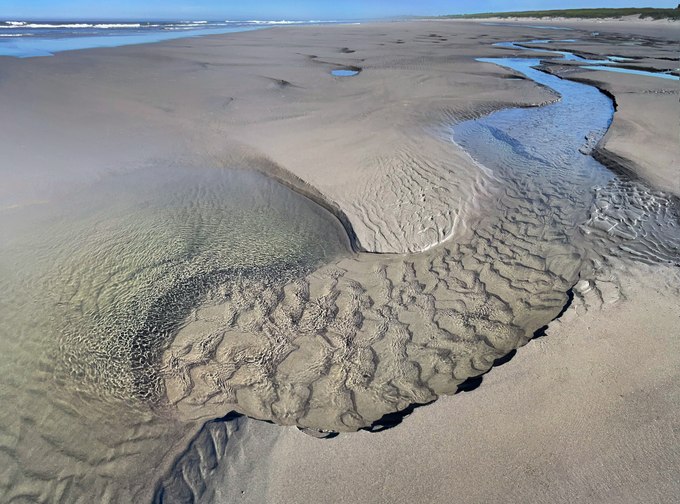
The beach at Gearhart on Oregon’s northwestern coast extends 20 miles north to where the Columbia River enters the Pacific. For untold millennia, the river has deposited sand north and south of its confluence with the ocean, and at Gearhart that sand has accumulated to depths of hundreds of feet.
The patterns of beach streams, sandbars, and wave ripples on the low-tide terrace continually shift with the strength of waves, winds, and tides. For residents like me, walking the beach is a daily ritual for cleansing the mind and calming the body, and a chance to witness the subtle and sometimes dramatic reconfigurations of the beach. I’ve noticed pronounced changes in the contours of the intertidal zone during the calm summer months, more than I anticipated.
I assumed the pounding waves and king tides of the previous winter wrought the only transformations to the beach profile. In fact, the smaller summer waves, normally no more than four feet high, actively push sand onto the upper beach, widening the berm that protects the dunes. In winter, its larger waves, averaging ten feet in height—and during storms as high as 30 feet—drag sand back out onto offshore bars.
This stream cascades across what, at other times of year, is an almost featureless stretch of sand. The morning low tide was well below normal, creating a steep gradient that, in turn, caused the stream to run more swiftly toward the ocean’s edge, scouring out tide pools and carving sharp-edged channels along its path.