
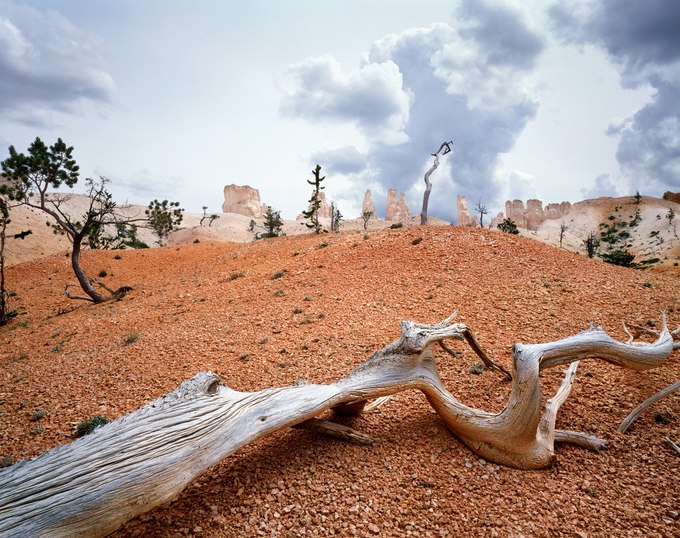
Southwestern Utah’s Bryce Canyon National Park is a visually stimulating wonder, with its colorful assemblage of sedimentary spires, ledges, and ravines. This soft rock erodes easily and, geologically speaking, has been here for only a moment in Earth’s history.
The cavernous topography that fills the park’s western section is best viewed from the high ridge overlooking its dramatic formations and from below along the winding trails that lead through them.
The park’s eastern section is a gently undulating plateau where a collection of young, widely spaced Great Basin bristlecone pines grows. This species, known for some of the oldest specimens on the planet (the oldest is 5000 years old), is usually found in higher-altitude settings subject to the forces of nature, with strong winds, cold temperatures, and short growing seasons. These conditions naturally protect it from insects and other creatures that would shorten its otherwise long life.
Here in this park, they grow out of a field of broken limestone, creating unfavorable conditions for most other plants and giving bristlecones room to grow. Their trunks and branches gesture playfully, almost anthropomorphic in expression. Smaller than their cousins elsewhere, these bristlecones are also younger; the oldest sprouted 1600 years ago. Erosion exposes their shallow roots, leaving their dense, resinous skeletons intact. Their sinuous remains are bleached by the sun and slowly sandblasted by the wind.