
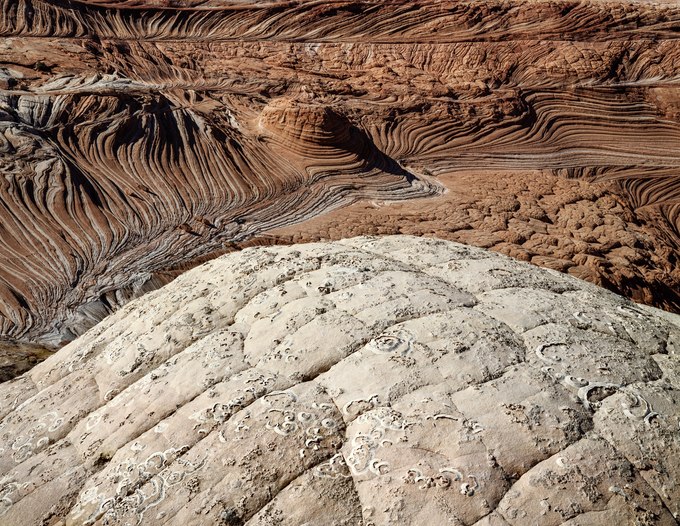
Unique, pristine landscapes hidden deep within the vast wilderness of the American Southwest take on an aura when they appear in the media. This happened at one such location on the Vermillion Plateau along the Utah-Arizona border, where an extraordinary sandstone formation was “discovered” in the 1990s through published films and photographs. They revealed a place that looked as if it had been imported from some exotic planet.
I had heard about this place in the 1980s from a couple of photography friends. Guided by rough directions, I almost got lost and finally stumbled upon this fantastic geologic display, spread over a few square miles at the end of a barely discernible path. No one else was there, unlike a decade later. And unlike now, I didn’t need to enter a lottery to get permission to visit.
Cross-bedded dunes were lithified into sandstone and eroded into the striking landforms known as Coyote Buttes. Over time, rain and especially wind revealed swirling layers, ribbons of color, and delicate fins. It was, and still is, a place of rawness and delicacy. Its rawness lay in the uneven, twisted terrain of soft, exposed rock. Its delicacy lies in how easily it crumbles underfoot.
A major cause of its distinctive deformation was dinosaurs trampling through ancient wet sand dunes, churning and contorting its layers. Its strata, now fossilized as rock, are eroded primarily by wind. In geologic time, this landscape is rapidly vanishing, and unfortunately careless visitors hasten the demise of its fragile beauty.