
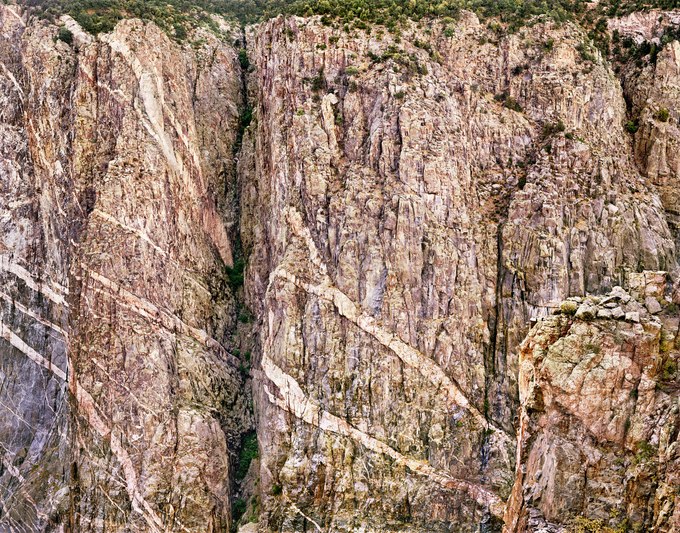
A favorite campground in western Colorado’s Black Canyon of the Gunnison National Park sits on the north rim, a quiet circle of sites among cedars, pinyons, and scrub oak. A short walk from my tent first brought me to the vertiginous cliffs of the Gunnison River. The view was awe-inspiring and frightening. Only my impatience to photograph this remarkable geological formation prompted me to approach the edge carefully, gingerly look down, and gaze across this chasm, unlike any I had seen elsewhere in the West.
“No other canyon in North America combines the depth, narrowness, sheerness, and somber countenance of the Black Canyon of the Gunnison,” wrote geologist Wallace Hansen. Carved by the erosive action of the Gunnison River, the canyon was excavated by the river’s voluminous flow and the force of its steep gradient. This powerful agent of erosion cleared rock debris that had fallen from the canyon walls, preserving their nearly vertical cliffs.
Precambrian rocks—hardened by heat and compression during an earlier era in Earth’s long history—comprise nearly all the walls and the floor of the Black Canyon. From the rim to the river, the deepest part of the canyon is the 2,000-foot Painted Wall. In this photograph, I saw how the wall got its name, veined with magma that was squeezed through fractures in the rock and cooled into light-toned, elegantly patterned intrusions. This scene reminds me of ancient Chinese mural paintings, with its flattened perspective and contours, and reduced shadows.