
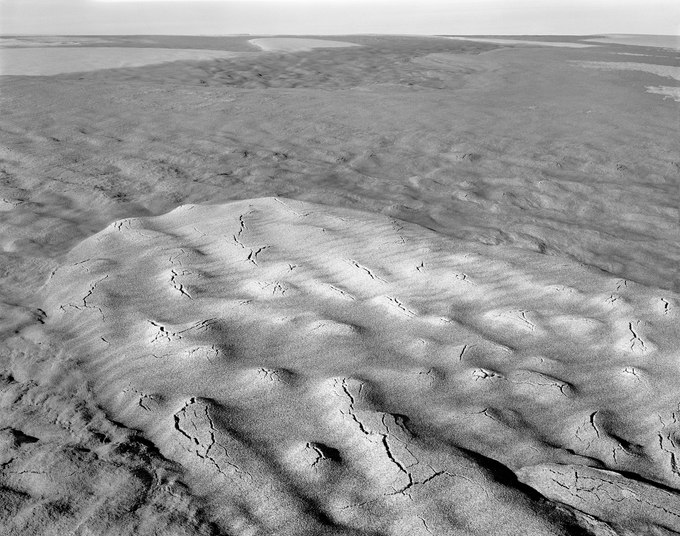
Walking across the dunes outside the coastal port of Provincetown on a rare, calm, sunny winter morning felt like crossing an arid wilderness, devoid of vegetation, open and flat. This landscape invited me to look down at the patterns in the sand until I came across one that, at first, made no sense. After making this photograph and learning more, I found that, in winter, these dunes are buffeted by winds that move the sand. Snow is often covered with sand blown in from the surrounding dunes and beach. Surface cracks and dimpled hummocks form as the snow beneath alternates between melting and freezing.
Describing the character of this desert, Henry David Thoreau wrote in his 1854 book “Cape Cod,” “None of the elements were resting. On the beach, there is a ceaseless activity, always something going on, in storm and in calm, winter and summer, night and day.” Eighteen thousand years ago, clay, rocks, and sand deposited by receding glaciers formed what would become Cape Cod. As sea levels rose to near present-day levels, the outer part of the cape took on the shape of a forearm. The northernmost reach of the cape (the fist) is where wind and ocean currents transported sand, forming sandbars that are continuously changing in size and height.
Originally covered by forests, the area was cleared by early settlers. As Thoreau noted, “the sands began to invade the land more and more, until finally they had entire possession from sea to sea…” Since the 18th century, Cape Codders have planted beach grasses. Today, the dunes are mostly grass-covered, and the extensive stretch of pure sand in this picture from fifty years ago no longer exists.