
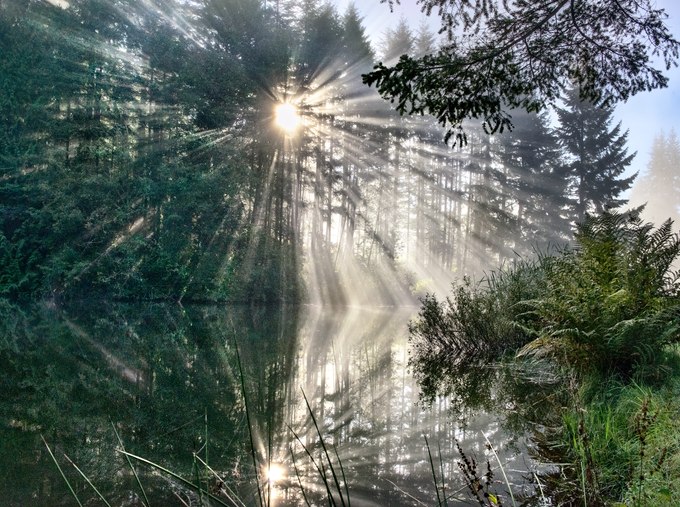
During early autumn in the Pacific Northwest, days grow short and nights grow cold, while ponds retain their summer heat longer. As the warm, moist air at the water’s surface of this former cattle pond mixed with the increasingly cooler night air, it condensed into an early-morning fog that lingered around and just above the shaded pool.
Sunlight seeped through gaps in the trees, forming a gentle, swirling, vaporous glow. People have interpreted these radiant streams of light and mist in many ways. Ancient Greeks believed that sunbeams drew water into the sky (an early depiction of evaporation). In the Old Testament, Jacob dreamed of a ladder reaching from earth to heaven, with angels ascending and descending it; this light is called Jacob’s Ladder. The Japanese term “Komorebi” roughly translates to “sunlight filtering through trees.” Komorebi—in the right place and at the right time—can evoke awe.
I’ve discovered that my favorite photographs are always surprises, scenes I couldn’t have imagined. In this case, all it took was pushing myself out the door of my cabin early one morning at Pilchuck Glass School. I planned to photograph Mt. Baker’s glaciers in the Northern Cascades, but this scene at my doorstep arrested my attention and delayed that plan. As I slowly moved around the pond, the fog felt like an animate presence, reshaping the light, then itself, and finally, under the rising sun, evaporating.