
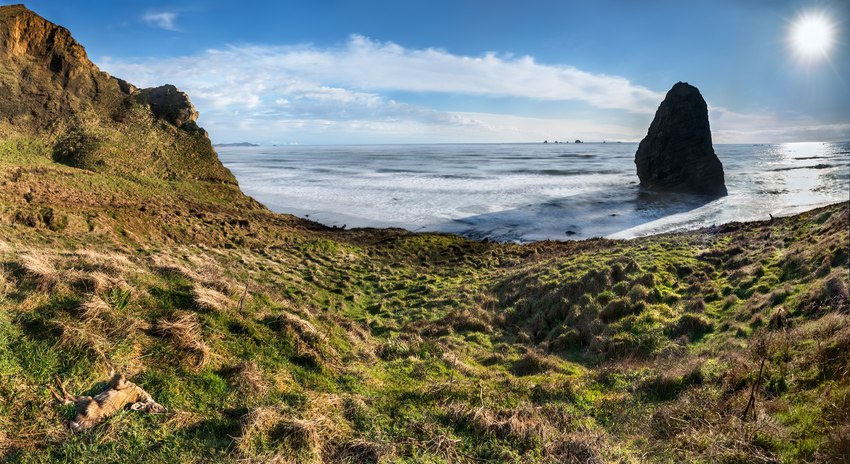
Descending the field that slumps off the south side of Cape Blanco’s headland, I stepped into a tangled heath. It was late winter when I made this photograph a few years ago, but even at its coldest, the marine climate of this coastal terrace allows the thick undergrowth to thrive, almost hiding a foraging mother porcupine and her two porcupettes. Giving them a wide berth, I came upon another young creature nestled in the grass, a fawn. It looked peaceful, though closer inspection revealed it had died, the cause unknown to me.
While mid-winter is almost always cloudy, wet, and fiercely windy, this late afternoon offered a respite. As I navigated farther down the banked meadow, I saw a bank of cumulus clouds receding south. The sea was relatively calm, the air still and clear, and the sun intensely bright after a storm’s passage. Needle Rock, a sea stack, cast its long shadow across the empty beach.
Etching the horizon, the Orford Reef looked like a school of whales. In fact, it is a cluster of eight small rock islands that provide habitat for marine wildlife, including anemones, fish, sharks, and nesting seabirds. Behind me rose a headland of sedimentary rock that over geologic time, had been rapidly uplifted from the sea. Along this coast, where tectonic plates collide, the floor of the Pacific Ocean pushes eastward into and under the North American continent, raising the former ocean floor 200 feet above sea level to form the state’s westernmost promontory.