
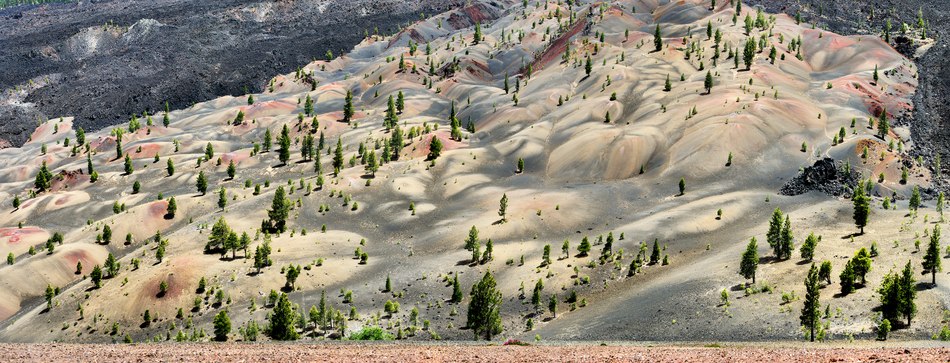
These colorful “painted” dunes lie at the foot of a 750-foot-high cinder cone that erupted in 1666 and was formed by the same eruptive activity that sculpted other parts of northern California’s Lassen Volcanic National Park. Hiking up a lava-ash trail, its loose surface softened by the pounding of many hiking boots, I found the climb to the cone’s crest more challenging than I had expected.
The top revealed a walkway akin to a floating platform that encircled a deep crevasse, the inverted center of the cone's sunken core. As remarkable as the view inside the collapsed volcano was, the view outward was even more incredible because it was so unexpected.
The dunes’ colors and highlighted tones resulted from volcanic ash falling onto hot lava that flowed from the base of the cinder cone. Around half of the cone’s base, extending out several hundred yards, titanium-rich ash landed on scorching lava and, through rapid oxidation, became lighter and more colorful than the dark ash that fell elsewhere on the relatively cooler surrounding lava field.
Because the ash and lava flows are nutrient-poor, the surrounding dunes and lava fields are almost devoid of vegetation. Over the past 350 years, the uncompacted ash has slowly allowed shallowly rooted plants to grow, and ponderosa trees have established themselves (albeit with limited growth) in the otherwise botanically desolate dunes. The whole scene was gratefully unmarked by footprints and left to natural erosion and the patterns it left behind, becoming its own painting.