
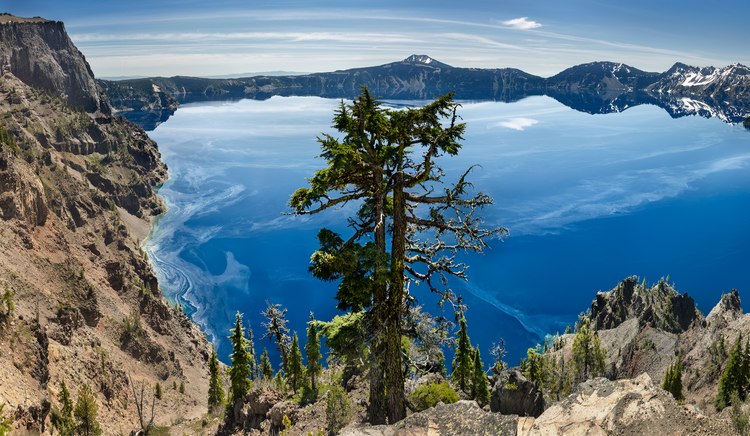
The pure water of central Oregon's Crater Lake absorbs all colors except those at the blue end of the visible spectrum. This hue becomes most vibrant in early summer, when the sun is highest in the sky. The light penetrates deeper into the lake, which then radiates back an almost surreal ultramarine cast.
Mid-morning in June several years ago, I took this photograph. The still lake reflected clouds above its eastern horizon, but I was surprised by something I hadn’t seen on prior visits: floating sheets of pollen.
This caldera, filled with water, is oval-shaped. The lake's origin is recounted in the oral histories of the Klamath People. Several thousand years ago, Mt. Mazama erupted, expelling large volumes of gas, ash, and cinders into the air. As the mountain's interior hollowed out from the explosion, what remained collapsed, leaving a deep sunken valley below the former peak that eventually filled with snow and rain. The lower edge of the mountain remained intact, becoming the lake’s cliffed rim.
Given how little organic matter enters the caldera, airborne pollen shed from lodgepole and ponderosa pines became one of the few sources of nutrients for the lake’s fungi, bacteria, and zooplankton. Depending on the fickle breezes caught in this sheltered basin, pollen curls around projecting outcrops, accumulating along its shore, and eventually sinking into this lakebed.