
TRAVELING THE LABRADOR COAST
I was first introduced to Newfoundland and Labrador by the book This Rock Within the Sea, written by Farley Mowat and illustrated with photographs by John de Visser. It documented a remarkably wild and visually thrilling landscape that appeared almost extraterrestrial.
Newfoundland is a large island just off the east coast of North America. Labrador, part of the same province, lies along the northeastern coast of the continent, north of Newfoundland. When I first visited the region in the early 1970s, I could not have imagined such rugged, open landscapes. Nor was I prepared for the outpost communities, with deep cultural ties to earlier centuries, evident in the customs and accents of its residents.
The province was first visited by Europeans a thousand years ago, when Vikings temporarily inhabited it. Beginning in the 1500s, the English, French, Irish, and Portuguese followed. For thousands of years until the 1600s, the province hosted migrations of peoples, including the Pre-Innu, Dorset, and Beothuk, all of whom either vanished after periods of settlement or, in the case of the Beothuk, died out; the last died in 1829. Today, the largest group of indigenous people is Labrador's Inuit.
In the late 1970s, I traveled to Labrador each summer, exploring dozens of isolated communities by coastal steamer, from the southernmost settlement of Red Bay, to Nain 420 miles north, the oldest continuous settlement in Labrador. The journey introduced me to a world that transitioned from a subarctic along Labrador's southern coast of Anglo settlements, to an Arctic environment northward, populated mainly by the Inuit. I carried an 8" x 10" wooden Deardorff view camera that my friend David Reinfeld lent me, which used large-format black-and-white film and medium-format color negative film, loaded into the view camera's film holders to shoot wide-angle panoramas.
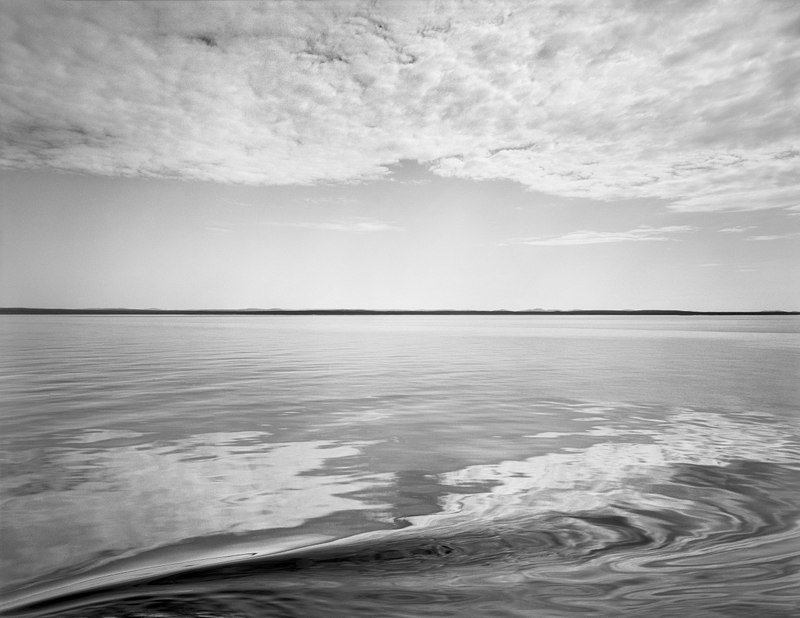
I traveled on either the MV Bonavista or the MV Nonia. These sister ships served the Labrador coast from early June until the sea ice froze the coast in December. During their trips, the vessels would make a dozen stops to drop off supplies such as food, lumber, and mail, and to load and unload passengers. Sometimes the ship would stop for an hour, then continue; sometimes it would moor overnight in the bay adjacent to a village, or tie up at the wharf if there was one.
Surrounded by sky and water, the coastline appeared as a thin line along southern Labrador’s horizon and as a thicker stripe of high, rolling mountains in the north. I would often fall into a trance, neither fully awake nor asleep, while gazing over the rail at the bow wave as it slipped off the side of the ship. And at night, I would sleep in a small cabin, if one was available, but most times I would sleep on the deck of the boat.
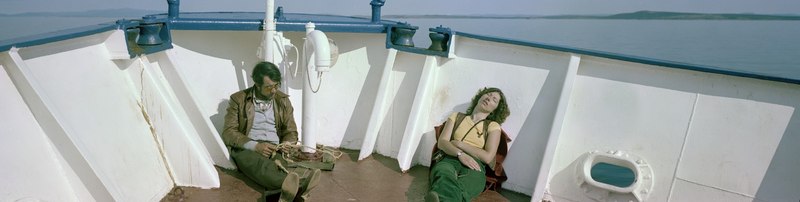
During the summer, the cold and wind that dominate the weather for most of the year relented, and calm seas and light winds invited passengers to spend the midday hours on deck, especially under the prow, where the deck was warmed by the southern sun as the ship headed north.
Outport residents, seasonal fishermen and their families, adventurous tourists, and some traveling for business made up the passengers. Conversations easily ensued about which settlements to avoid visiting while docked, such as a traditional Mushuau Innu First Nation village in Davis Inlet, which for many years, understandably, did not welcome outsiders. And, conversely, which towns were best to disembark. Ones that took boarders with a bed and meals, where one could stay in a family’s extra bedroom and explore the area until boarding the next ship that came through a week or so later.
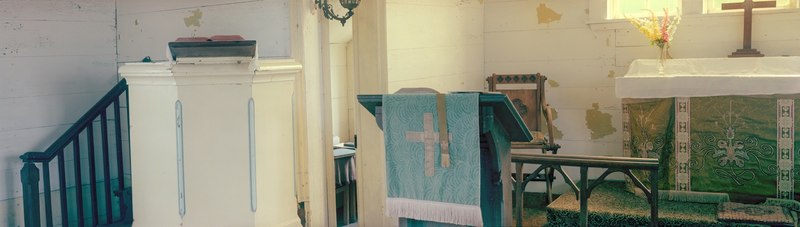
One place where I spent a week was Battle Harbour on Battle Island, just off the mid-coast of Labrador. In the mid-19th century, an Anglican Church was built when Battle Harbour was considered the capital of the Labrador coast, with a waterfront of wharves and salt barns for receiving, salting, packing, and exporting catches of salmon, cod, and herring. This church has remained fundamentally unchanged in appearance since I photographed its chancel half a century ago.
Behind the church stood a parsonage where painter Frederick Edwin Church stayed during the summer of 1859, sketching and painting drifting icebergs along Iceberg Alley, where large icebergs skirt the coast in early summer. Some of the icebergs, melting quickly in the summer heat, would split and crash, creating large waves. One of these waves nearly capsized Church’s boat and, at the same time, inspired his painting “The Icebergs”. Now hanging in the Dallas Art Museum, it is one of the best-known works by a leading member of the Hudson River School of 19th-century painters.
Today, Battle Harbour, once a populated center of commerce, is no longer a fishing station and has been restored as a National Historic Site for visitors.
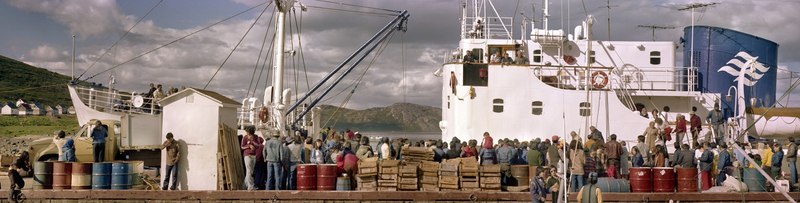
The northern part of the Labrador coast (there are no settlements in its interior) is inhabited almost entirely by Inuit, though a small number of Anglos live there as well. Considered part of “The North” (slang for the region north of Labrador’s mid-coast), Nain is one of the largest Inuit towns and one of the oldest continuously settled communities in the province, established by Moravian missionaries in 1771.
The late 1970s, when I visited, were a period of cultural disruption in northern Labrador, marked by the forced government resettlement of Inuit villages farther north into Nain. This broke the culture’s traditional lifeways, especially its hunting and fishing practices, and, ironically and importantly, marked the beginning of a reassertion of the value of their traditions.
One of the most obvious disruptions was seeing government-built homes with families watching soap operas on television and thinking that was what life was like in “The South,” which almost none had seen firsthand. At the same time, an influx of cultural anthropologists interviewed these indigenous Labradorians about their lifestyles, unintentionally prompting them to question their way of life.
This ship was one of the first to bring in new types of living supplies, including, notoriously (or maybe apocryphally), toilet paper. Taken together, these developments and disruptions initiated a process in which residents began reclaiming their cultural identity.
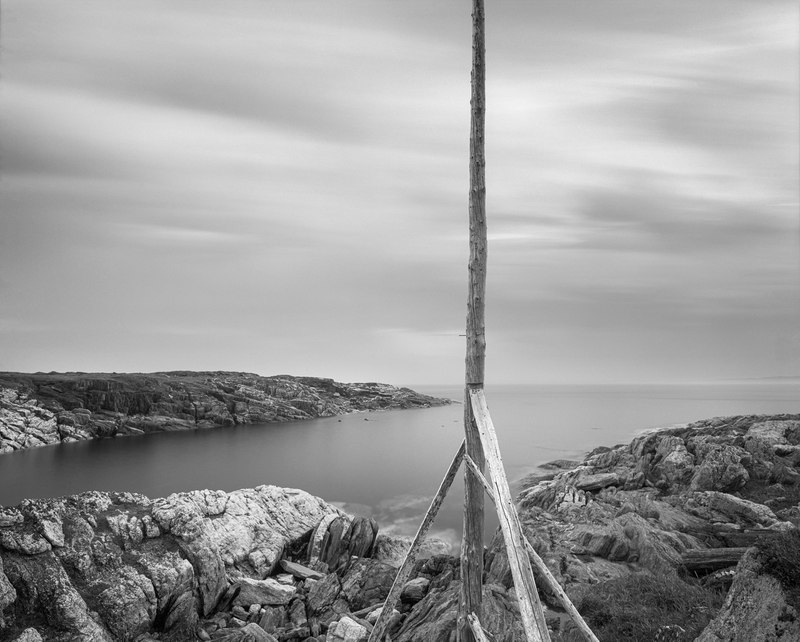
Along Labrador’s coast are markers, sometimes stone piles on hilltops that residents used to call “American Men” because American military personnel built them, and in other places, poles scaffolded with lumber. Until this time the markers I had become accustomed to were cairns, rock piles used out West to mark trails for hikers. Similarly, these were erected to mark locations such as an inlet or harbor, like this pole near Nain, or to help determine one’s location before radio direction finders or Loran stations were introduced in WWII.
Traveling north, the landscape transitions into the Arctic tundra, resembling a desert, devoid of vegetation other than low shrubs, mosses, lichens, and grasses. The treeline (the northernmost extent of trees) lies south of Nain, so all lumber that far north comes from shipwrecks, floated ashore as driftwood, or is shipped in by boat, making it a rare but valuable commodity.
Afterword:
A recent humorous television series, North of North (Netflix), created by Inuit actors and scriptwriters, tells the story of reclaiming their way of life while pushing back against and adapting to certain aspects of modernity. It recalled of my travels half a century ago to communities like the one portrayed in this television show, and even though it was made for television, it mirrored aspects of my experiences.
At the same time, it reminded me that photography is an elegiac art form that freezes a moment in time and preserves it. Of course, what was once captured no longer exists. The places I visited still have the same geographic coordinates in latitude and longitude, and certain artifacts remain. But that coordinate of time no longer exists except in memory.