
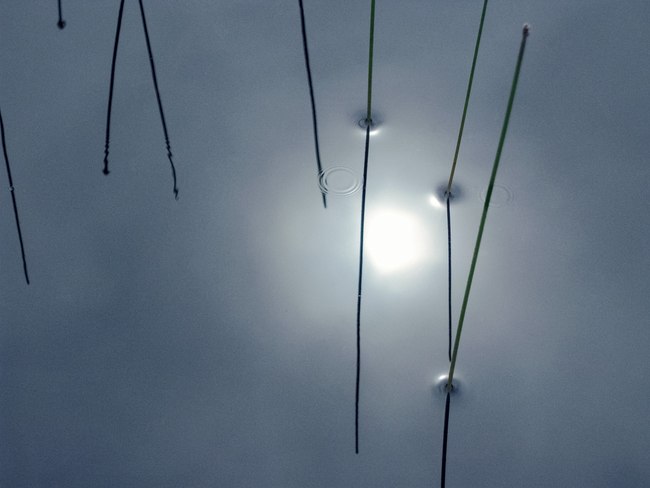
Along the rugged coast of southwestern Newfoundland, headlands rise abruptly from the sea, rivers are short and turbulent, and a landscape of granite outcroppings, boreal forests, and rolling barrens of peat bogs is interspersed with ponds, lakes, and rivers. During the short summers, shallow ponds blossom with lily pads, reeds, and rushes. This region of the Atlantic, where the cold Labrador Current intersects with the warm Gulf Stream, produces ample rainfall and an ever-present mist that filters the sun.
When hiking along one of the few trails that head inland from the Newfoundland coast, I felt as though I was dissolving into this uninhabited landscape that stretched to the horizon. A track between hills followed a stream stained tea-colored by runoff from peat-moss bogs. In the brief calm of midsummer, still ponds became black mirrors, casting silhouettes of aquatic plants against the dull-blue reflection of a fog-filled sky.
Kneeling, I moved in close to the fen’s flat surface, where rushes breached air and water. At their intersection, their stalks caused the pond's film to curve into a concave dimple as they drew water up their sides, creating barely visible convex rings encircling their stems. Between the stalks, the energy of two falling drops of water hitting the pond created a barely discernible repeating pattern of ripples. A soft chromatic glow radiated outward from the sun’s reflection, shifting from blue to red. Here, the landscape revealed itself at an intimate scale, sheltered within a vast, time-worn terrain.