
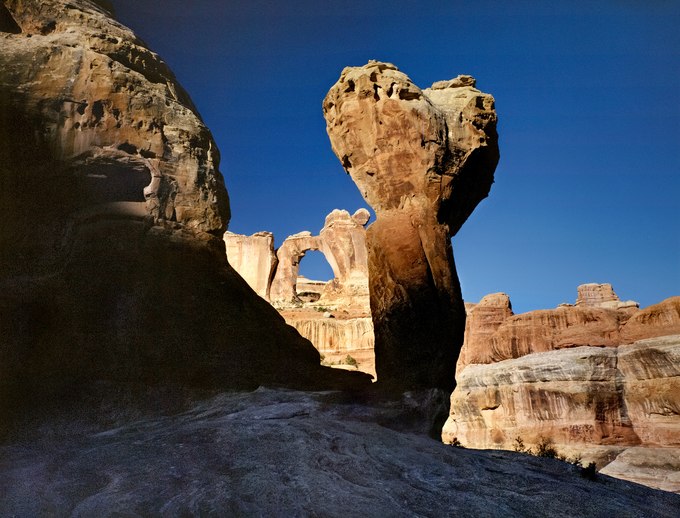
Hiking up a side canyon at sunrise after camping along the Salt Creek Trail in southeastern Utah’s Needles District of Canyonlands National Park, my son and I came upon these geologic wonders. In the foreground, a precariously balanced rock informally named The Molar—it looks like a large, extracted tooth—stands before an even more prominent sandstone feature, Angel Arch. This, too, has an anthropomorphic name because it resembles an angel with folded wings leaning against an arch.
These unusually large and fantastical creations glow in the raking light of early morning, when the bright, warm sun starkly outlines them while skylight fills the deep shadows with a blue cast. Their scale was difficult to gauge, forcing us to lean far back and move around to take them in. They were simply overwhelming, and any effort to grasp their dimensions was pushed from my mind by how impenetrable they were, standing upright against the slow weathering of time.
Solid as they appeared, I imagined, as I moved closer, that they were coated in a thin façade, like a papier-mâché exterior that, once scraped away, revealed skeletal scaffolding. As it was, they were stained red with iron leached by rain, streaked here and there with bands of dark varnish, and scoured with hollows everywhere across their outer shell. I brushed their surfaces, finding them rough, smooth, warm, and cold, and, finally, pressing hard against them, I was reminded they are as unyielding as ancient stone.